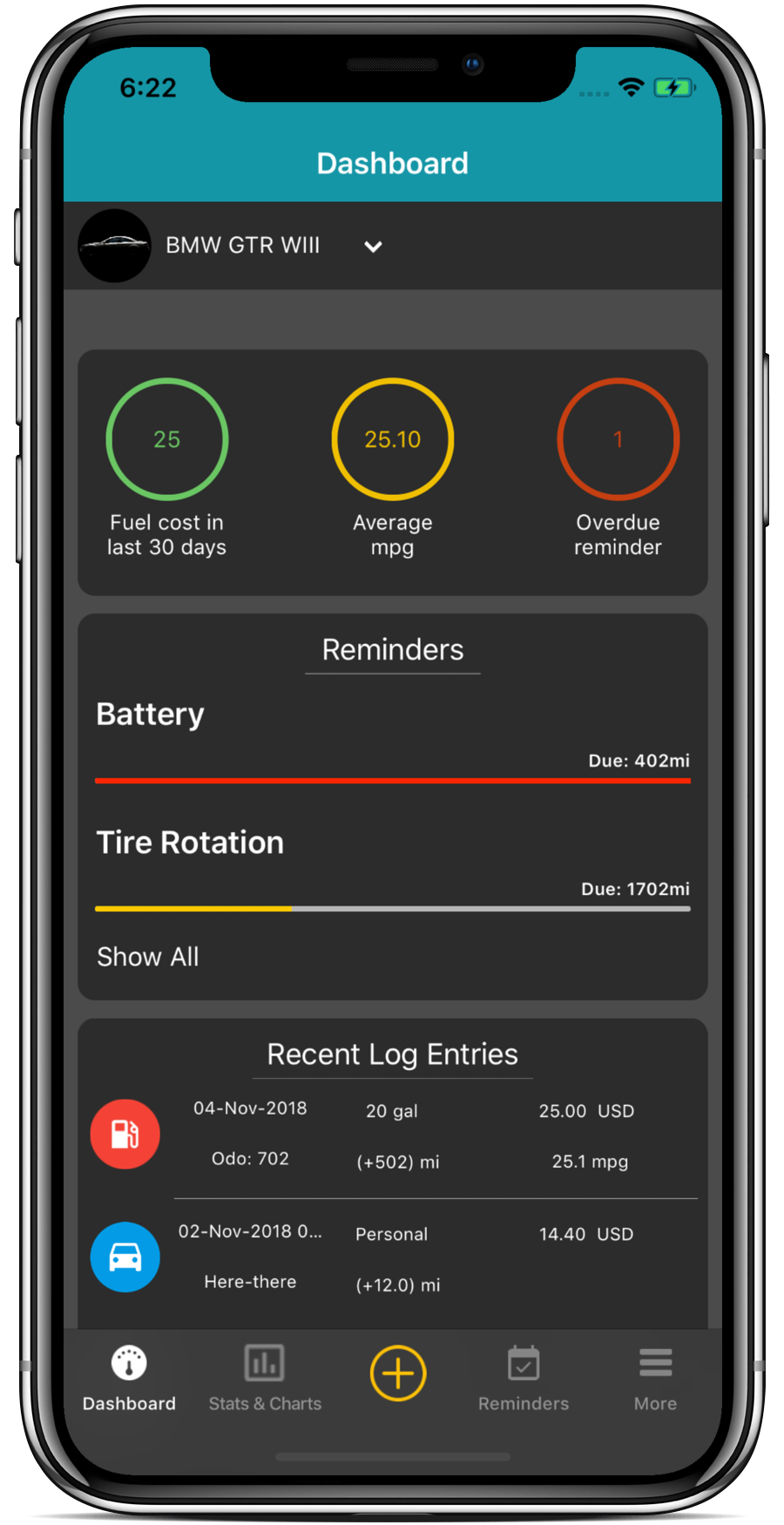
Record fill-ups for all your cars and monitor your car’s efficiency.
Need to track business mileage? Just start auto trip and we will track all your trips in the background whenever you are on the move.
Don’t lose sight of your maintenance and services. Log your services and we will remind you when its due.
Know your vehicle's running costs and plan for your expenses.
Sign into the cloud and get easy access to all your data from anywhere and any device.
Run your reports or schedule them weekly or monthly to know more about your fill-ups , mileage and expenses.
The DPHN 142 recommendation is to spend no more than 25% of your weekly entertainment time in the Low Energy/Low Cog quadrant. How does this theoretical knowledge translate into daily habits? Here are three case studies typical of a DPHN 142 Lifestyle and Entertainment course. Case Study A: The Streamer’s Lament Scenario: A 22-year-old university student watches 35 hours of streaming content per week and reports chronic fatigue, poor grades, and weight gain. DPHN 142 Intervention: The student swaps 10 of those hours for "active entertainment"—joining a local recreational volleyball league and listening to audiobooks (a form of high-cog, low-energy entertainment) during commutes. Result: After 8 weeks, sleep quality improved by 40%, and social anxiety decreased significantly. Case Study B: The Gamer’s Gain Scenario: A 30-year-old software engineer plays MMORPGs for 20 hours weekly but feels isolated. DPHN 142 Intervention: Rather than reducing game time, the course suggests modifying the format —inviting coworkers to a weekly LAN party or switching to co-op narrative games that require verbal communication. Result: The individual maintains their hobby but transforms it into a team-building, mood-enhancing ritual. Case Study C: The Social Media Cleanse Scenario: A retiree spends 5 hours daily on Facebook, leading to comparison depression. DPHN 142 Intervention: The retiree replaces 3 of those hours with "generative entertainment"—writing short film reviews or creating a gardening blog (moving from consumer to creator). Result: A renewed sense of purpose and a 60% reduction in passive screen time. Why DPHN 142 is More Relevant Now Than Ever We are living through the Attention Economy , where every app, show, and notification is vying for a slice of your time. Traditional public health models focus on diet and exercise, but they often ignore the primary driver of sedentary behavior: entertainment.
In the rapidly evolving digital age, where content is king and connection is currency, finding a structured yet vibrant approach to daily living can feel overwhelming. Enter DPHN 142 Lifestyle and Entertainment —a concept that has quietly become a cornerstone reference for educators, students, and lifestyle enthusiasts who seek to understand the intricate dance between our personal habits and the media we consume. dphn 142 hot
| Quadrant | Example | Lifestyle Impact | | :--- | :--- | :--- | | | Strategy sports (chess boxing), Escape rooms, Competitive e-sports | Ideal : Builds resilience and teamwork. Risk : Burnout. | | High Energy / Low Cog | Running to a podcast, Dancing to pop music, Casual hiking | Ideal : Best for physical health. Risk : Minimal cognitive growth. | | Low Energy / High Cog | Reading a novel, Watching a documentary, Playing puzzle games | Ideal : Intellectual stimulation. Risk : Sedentary posture. | | Low Energy / Low Cog | Binge-watching reality TV, Mindless scrolling, ASMR videos | Neutral/High Risk : Useful for recovery, but addictive. | The DPHN 142 recommendation is to spend no
Furthermore, universities are now offering for corporate wellness programs. Companies are realizing that an employee who manages their entertainment habits effectively is more focused, less burnt out, and more creative. Conclusion: Your Life is the Main Feature The core takeaway from DPHN 142 Lifestyle and Entertainment is elegantly simple: Don't let your entertainment be the backdrop of your life; make your life the main feature, and let entertainment be the supporting actor. Case Study A: The Streamer’s Lament Scenario: A
Imagine a future where your AI assistant doesn't just recommend a movie based on what you liked before, but based on your current heart rate, sleep debt, and social calendar . That is the DPHN 142 vision: algorithmic entertainment that prioritizes your holistic health over engagement metrics.

The DPHN 142 recommendation is to spend no more than 25% of your weekly entertainment time in the Low Energy/Low Cog quadrant. How does this theoretical knowledge translate into daily habits? Here are three case studies typical of a DPHN 142 Lifestyle and Entertainment course. Case Study A: The Streamer’s Lament Scenario: A 22-year-old university student watches 35 hours of streaming content per week and reports chronic fatigue, poor grades, and weight gain. DPHN 142 Intervention: The student swaps 10 of those hours for "active entertainment"—joining a local recreational volleyball league and listening to audiobooks (a form of high-cog, low-energy entertainment) during commutes. Result: After 8 weeks, sleep quality improved by 40%, and social anxiety decreased significantly. Case Study B: The Gamer’s Gain Scenario: A 30-year-old software engineer plays MMORPGs for 20 hours weekly but feels isolated. DPHN 142 Intervention: Rather than reducing game time, the course suggests modifying the format —inviting coworkers to a weekly LAN party or switching to co-op narrative games that require verbal communication. Result: The individual maintains their hobby but transforms it into a team-building, mood-enhancing ritual. Case Study C: The Social Media Cleanse Scenario: A retiree spends 5 hours daily on Facebook, leading to comparison depression. DPHN 142 Intervention: The retiree replaces 3 of those hours with "generative entertainment"—writing short film reviews or creating a gardening blog (moving from consumer to creator). Result: A renewed sense of purpose and a 60% reduction in passive screen time. Why DPHN 142 is More Relevant Now Than Ever We are living through the Attention Economy , where every app, show, and notification is vying for a slice of your time. Traditional public health models focus on diet and exercise, but they often ignore the primary driver of sedentary behavior: entertainment.
In the rapidly evolving digital age, where content is king and connection is currency, finding a structured yet vibrant approach to daily living can feel overwhelming. Enter DPHN 142 Lifestyle and Entertainment —a concept that has quietly become a cornerstone reference for educators, students, and lifestyle enthusiasts who seek to understand the intricate dance between our personal habits and the media we consume.
| Quadrant | Example | Lifestyle Impact | | :--- | :--- | :--- | | | Strategy sports (chess boxing), Escape rooms, Competitive e-sports | Ideal : Builds resilience and teamwork. Risk : Burnout. | | High Energy / Low Cog | Running to a podcast, Dancing to pop music, Casual hiking | Ideal : Best for physical health. Risk : Minimal cognitive growth. | | Low Energy / High Cog | Reading a novel, Watching a documentary, Playing puzzle games | Ideal : Intellectual stimulation. Risk : Sedentary posture. | | Low Energy / Low Cog | Binge-watching reality TV, Mindless scrolling, ASMR videos | Neutral/High Risk : Useful for recovery, but addictive. |
Furthermore, universities are now offering for corporate wellness programs. Companies are realizing that an employee who manages their entertainment habits effectively is more focused, less burnt out, and more creative. Conclusion: Your Life is the Main Feature The core takeaway from DPHN 142 Lifestyle and Entertainment is elegantly simple: Don't let your entertainment be the backdrop of your life; make your life the main feature, and let entertainment be the supporting actor.
Imagine a future where your AI assistant doesn't just recommend a movie based on what you liked before, but based on your current heart rate, sleep debt, and social calendar . That is the DPHN 142 vision: algorithmic entertainment that prioritizes your holistic health over engagement metrics.

Simply Fleet is a simple and affordable software to help you track, monitor and analyse your fleet’s operations.